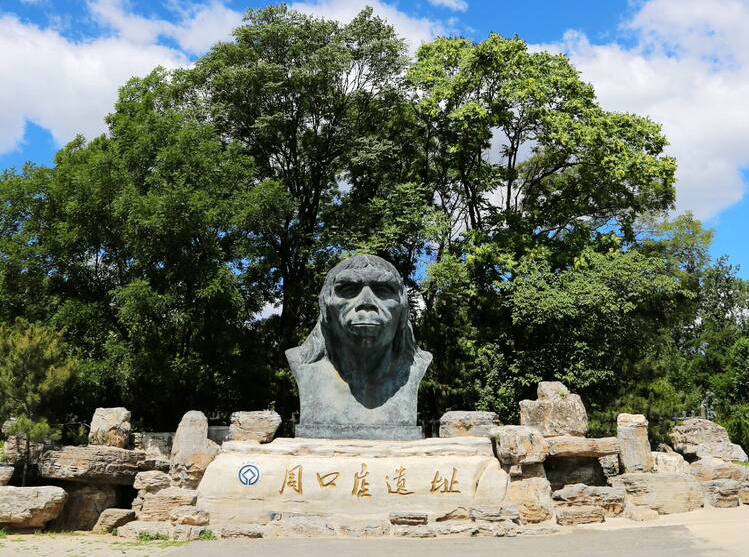
Peking Man site at Zhoukoudian
Overview
The Peking Man site at Zhoukoudian, located approximately 50 kilometers southwest of Beijing, is a crucial paleoanthropological site that provides significant insights into human evolution. This site, renowned for its rich archaeological and paleoanthropological value, marks the habitation of Homo erectus pekinensis, commonly referred to as Peking Man, who lived from approximately 750,000 to 230,000 years ago. The Zhoukoudian site has been recognized globally, having been designated a UNESCO World Cultural Heritage site in 1987. It is a pivotal location for understanding the early stages of human civilization, offering invaluable evidence of prehistoric human life through a comprehensive collection of fossils, stone tools, and other cultural relics.
Historical and Excavation Background
Zhoukoudian's significance as a cultural heritage site is underscored by its extensive fossil record, which spans several prehistoric periods. First excavated in the 1920s, Zhoukoudian has since yielded an array of fossils and artifacts that document the progression of early human species. The site was officially recognized for its historical and cultural significance at the national level in China in 1961 and listed as a UNESCO cultural heritage site in 1987. It has been a focal point for research into human origins, playing a crucial role in tracing the evolutionary journey from early hominins to modern humans. The site's historical importance is also reflected in the establishment of the Zhoukoudian Site Museum, inaugurated in 1953, which serves to preserve and showcase the rich archaeological finds from the area.
The discovery of the Peking Man site at Zhoukoudian was marked by the groundbreaking excavation in 1929, during which the first complete fossilized skullcap of Peking Man was unearthed. This discovery was momentous, providing concrete evidence of early human life in the region. Subsequent excavations in the 1930s revealed additional skulls, jawbones, teeth, and other skeletal fragments, contributing to the understanding of Peking Man's physical characteristics and lifestyle. The site has continued to be a rich source of paleoanthropological findings, with systematic excavations uncovering a wealth of fossils and artifacts over the decades. These include the remains of the New Cave Man and Upper Cave Man, revealing a continuity of human evolution at Zhoukoudian.
Archaeological Findings
The archaeological findings at Zhoukoudian encompass a wide array of fossils and artifacts that provide a window into the life and environment of early humans. These findings include the remains of Peking Man, a species of Homo erectus that lived during the Middle Pleistocene, as well as tools and evidence of fire use. The site has yielded six skulls, numerous jawbones and teeth, and over 100,000 stone tools, illustrating the technological capabilities of early humans. The use of fire, evidenced by ash deposits and burnt bones, marks a significant milestone in human development. The discovery of tools and cultural artifacts, such as bone needles and accessories, further illustrates the evolving complexity of human behavior and social organization during this period.
Peking Man
Peking Man refers to the fossilized remains of Homo erectus pekinensis, a subspecies of Homo erectus, discovered at Zhoukoudian. These early humans lived approximately 230,000 to 750,000 years ago and are characterized by their notable cranial capacity, estimated at 1,088 milliliters, compared to the modern average of 1,400 milliliters. Peking Man's physical attributes included an average height of 156 cm for males and 150 cm for females. Evidence suggests that Peking Man had developed the ability to use fire and create stone tools, which were crucial for hunting and survival. Despite their advancements, the life expectancy of Peking Man was relatively short, with the majority living only up to 14 years and a small fraction reaching 50 years.
Evolution from Ape to Man
The evolutionary journey from ape to man is vividly illustrated at the Peking Man site in Zhoukoudian. The site provides evidence of the gradual transition from primitive hominins to more anatomically modern humans. The fossils found at Zhoukoudian demonstrate a clear progression in physical and cognitive traits, marking significant steps in human evolution. The use of tools and fire by Peking Man signifies a critical divergence from their ape ancestors, highlighting the development of skills that define humanity. The discoveries at Zhoukoudian have been instrumental in resolving debates over the classification of early human species, particularly in distinguishing between apes and early hominins. The site's layered deposits, containing fossils and cultural artifacts, serve as a chronological record of the evolutionary advancements of early humans over thousands of years. Article reference1. Skull fragment belongs to ancient human. chinadaily.com.cn. 20232. Zhoukoudian National Archaeological Site Park, Beijing. chinaservicesinfo.com. 20213. Museum restores life scenes of Peking Man. chinaservicesinfo.com. 20214. Experts mark 90th anniversary of Peking Man skull discovery. chinadaily.com.cn. 20195. Peking Man Site at Zhoukoudian. chinaservicesinfo.com. 2018Photo Gallery(10 pictures)CategoriesCultural HeritageTagWorld Heritage in ChinaTangible Cultural HeritageWorld HeritageArchaeological DiscoveryCatalogue1. Overview2. Historical and Excavation Background3. Archaeological Findings4. Peking Man5. Evolution from Ape to Man- - - []








